
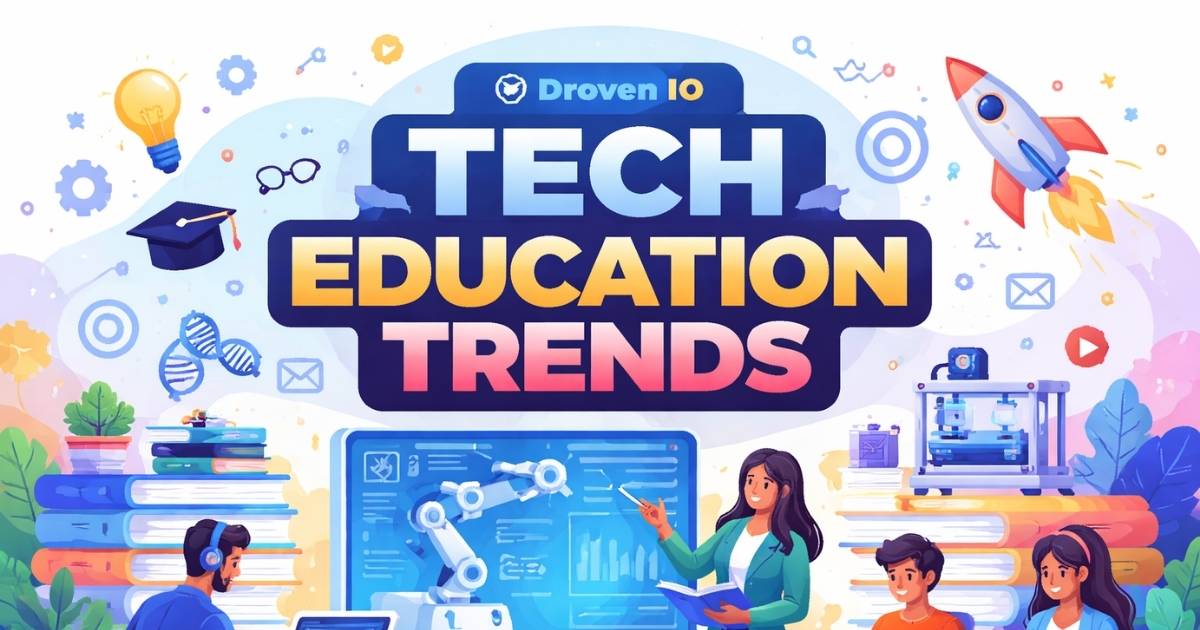
Education has never changed this fast. A few years ago, the idea of an AI tutor adjusting lessons in real time or a student practicing surgery through a VR headset sounded like science fiction. Today, these are classroom realities. The Droven IO tech education landscape in 2026 reflects a world where learning is no longer confined to four walls, a fixed schedule, or a one-size-fits-all curriculum.
This article breaks down the most important education technology trends shaping learning right now and in the years ahead, covering everything from artificial intelligence and immersive tools to cybersecurity awareness and stackable credentials.
The Evolution of Education Technology
EdTech has moved through several clear phases. First came digitization, when textbooks went online. Then came connectivity, when students gained access to global learning platforms. Now we are in the intelligence phase, where AI, cloud computing, data analytics, and immersive technologies are working together to create learning ecosystems that adapt to every individual.
The global educational technology market is projected to reach $348 billion by 2030, growing at an annual rate of over 13%. These numbers reflect something deeper than investment. They reflect a shift in how society defines learning itself.
Artificial Intelligence in Education
Artificial intelligence is the single most transformative force in education technology today. It is not just one tool. It is a layer that makes every other tool smarter.
Personalized Learning Experiences
AI systems analyze student performance data, learning preferences, and pace to deliver customized content in real time. If a student struggles with a concept, the system adjusts difficulty, offers alternative explanations, and provides targeted practice. This kind of adaptive learning was once available only to students with private tutors. AI has made it scalable for millions.
Read More: Truzio Explained: Smart Business and Digital Transformation, Solutions in 2026
Intelligent Tutoring Systems
Intelligent tutoring systems go beyond simple quizzes. They engage students in dialogue, track reasoning patterns, and provide step-by-step guidance. These systems are particularly powerful in STEM subjects, where understanding process matters as much as getting the right answer.
Automated Assessment
Grading used to consume enormous amounts of teacher time. AI-powered automated assessment tools now evaluate written responses, code, and even oral answers with high accuracy. This frees educators to focus on mentoring, creativity, and the human aspects of teaching that technology cannot replace.
The Importance of AI Literacy
Knowing how to use AI tools is not enough anymore. Students need to understand how AI works, where it can fail, and what ethical responsibilities come with it. AI literacy is quickly becoming a foundational skill, on par with reading and mathematics.
Key Components of AI Literacy
Building genuine AI literacy means covering several interconnected areas:
- Understanding how AI systems make decisions and what data they rely on
- Recognizing bias in AI outputs and knowing how to question them
- Ethical use of AI tools in academic and professional settings
- Data privacy awareness, including how personal information is collected and used
- Practical AI application skills for real workplace tasks
Universities like SUNY have already embedded AI literacy into general education requirements for all incoming undergraduates, setting a precedent that institutions worldwide are following.
Immersive Learning with VR and AR
Virtual reality and augmented reality are transforming passive learning into active experience. Instead of reading about a historical event, students walk through it. Instead of studying a chemical reaction from a diagram, they observe it in a virtual lab.
Real-World Simulations
Medical students practice procedures before stepping into an operating room. Engineering students stress-test structural designs in virtual environments. Flight simulators have trained pilots for decades, and that same logic is now being applied across every professional field.
Enhanced Engagement
Research consistently shows that immersive learning environments improve attention, motivation, and emotional connection to content. When learners feel present inside a lesson, they retain more.
Read More: Revolvertech Gaming 2026: Secrets, Reviews & Hidden Insights
Practical Applications
VR and AR are now being deployed in:
- Vocational training for skilled trades
- Language immersion programs
- Corporate onboarding and safety training
- History and social studies education
- Architecture and design courses
Hardware costs are dropping, and content creation tools are becoming accessible to educators without technical backgrounds.
Skills-Based Learning Approach
Employers are increasingly less focused on what degree a candidate holds and more focused on what that candidate can actually do. This shift has pushed education toward a skills-based model that prioritizes demonstrable competencies over seat time.
Why Skills Matter
The LinkedIn 2023 Workplace Report found that 92% of talent professionals consider soft skills just as important as technical ones. Critical thinking, communication, adaptability, and problem-solving consistently rank at the top of employer wish lists, alongside technical skills like coding, data analysis, and digital design.
Project-Based Learning
Project-based learning puts students in the role of problem solvers working on real challenges. Instead of answering test questions, they build products, design systems, and present findings. This approach develops both technical skills and the collaborative mindset that workplaces demand.
Career Readiness
Skills-based programs are closing the gap between graduation and genuine employability. Students leave with portfolios, work experience, and the confidence that comes from having solved real problems.
Cloud Computing and Automation
Cloud technology has quietly become the backbone of modern education. It is what makes remote learning reliable, collaborative tools seamless, and data-driven instruction possible at scale.
Access to Resources
Cloud platforms give students access to powerful software and vast learning libraries from any device, without expensive hardware or institutional infrastructure. A student in a rural area can access the same tools as someone at a well-funded urban institution.
Hands-On Experience
Cloud environments allow students to practice in real computing environments, deploying applications, managing databases, and running experiments without risk. AWS, Google Cloud, and Microsoft Azure all offer educational programs for exactly this purpose.
Automation Skills
Understanding automation is now a core workplace competency. Students who learn to design, deploy, and manage automated workflows gain an enormous advantage in nearly every professional field.
Flexible and Hybrid Learning Models
Rigid schedules and single-location learning are giving way to models that meet students where they are, both physically and in terms of their stage of life.
Online and Offline Integration
Hybrid learning blends in-person instruction with digital coursework, giving students the benefits of direct human interaction and the flexibility of self-directed online study. Institutions that do this well report higher completion rates and greater student satisfaction.
Self-Paced Learning
Not every learner moves at the same speed, and they should not have to. Self-paced programs allow individuals to accelerate through material they grasp quickly and spend more time on areas where they need support.
Global Accessibility
Online learning has made it possible for a student in Karachi to take a course delivered by an instructor in Berlin and earn a credential recognized by an employer in New York. This global accessibility is fundamentally changing who gets to participate in quality education.
Microlearning and Short Courses
Attention spans are shrinking, schedules are tighter, and the pace of workplace change means that what people need to learn changes faster than traditional courses can keep up with.
Bite-Sized Content
Microlearning delivers focused lessons in short modules, typically under 10 to 20 minutes. Each module covers one concept thoroughly, without the padding of traditional course formats. This approach aligns with how people actually absorb information.
Time Efficiency
Professionals cannot take three months off to upskill. Short courses, weekend intensives, and on-demand modules allow continuous learning without career interruption. By 2026, AI is making these modules even smarter, triggering the right lesson based on a learner’s current tasks or recent performance gaps.
Continuous Improvement
Microlearning supports a culture of ongoing development rather than one-time education events. Learning becomes a daily habit rather than a periodic disruption.
Data-Driven Education
Every interaction a student has with a digital learning platform generates data. Used responsibly, this data is one of the most powerful tools educators have ever had.
Performance Tracking
Learning analytics dashboards give educators a real-time view of student engagement, comprehension, and progress. Early warning systems flag students who may be falling behind before they reach a crisis point.
Personalized Feedback
Data enables feedback that is specific, timely, and actionable. Rather than waiting for a mid-semester grade, students receive immediate insights about what they know and what they need to work on.
Better Decision-Making
Institutions use aggregate learning data to evaluate curriculum effectiveness, identify equity gaps, and allocate resources more strategically. This turns gut-feeling decisions into evidence-based ones.
Gamification in Learning
Gamification takes the motivational mechanics that make games compelling, such as points, badges, leaderboards, challenges, and rewards, and applies them to learning environments.
Motivation and Engagement
Research shows that gamification can improve educational outcomes by more than 45%, and challenge-based gamification can increase eLearning effectiveness by nearly 90%. These numbers reflect a simple truth: people work harder when they are engaged.
Interactive Learning
Gamified learning environments encourage active participation rather than passive consumption. Students make decisions, experience consequences, and try again, which is how deep learning actually happens.
Improved Retention
Game mechanics create emotional investment. When a student is working to unlock the next level or beat their personal best score, they are motivated to remember what they learned last time.
Cybersecurity and Ethical Awareness
As education becomes more digital, protecting student data and teaching responsible technology use has become essential rather than optional.
Data Protection
Educational institutions hold enormous amounts of sensitive student data. Robust encryption, multi-factor authentication, and proactive threat detection are now standard requirements for any credible EdTech platform.
Ethical Technology Use
Students need to understand digital footprints, misinformation, intellectual property, and the ethical implications of AI-generated content. These are not electives. They are survival skills for the modern world.
Cybersecurity Skills
For students entering the workforce, cybersecurity knowledge is a competitive advantage in virtually every sector. Understanding basic threat models, safe practices, and data governance prepares graduates for a landscape where every organization faces digital risk.
Lifelong Learning and Continuous Upskilling
The idea that education ends at graduation is obsolete. The skills that land a job today may be insufficient within five years as technology continues reshaping industries.
Rapid Technological Changes
AI, automation, and emerging technologies are eliminating some roles while creating new ones that did not exist a decade ago. Workers who commit to continuous learning are far better positioned to adapt and thrive.
Career Advancement
Professionals who actively upskill earn more, advance faster, and are more resilient during economic disruptions. Employers increasingly value learning agility alongside existing credentials.
Stackable Credentials and Certifications
Not everyone can commit to a four-year degree, and not every job requires one. Stackable credentials offer a modular path to professional qualification.
Modular Learning
Stackable credentials let learners build toward larger qualifications over time. Completing a certificate in data analysis can stack toward a broader data science qualification, which can eventually credit toward a degree. This reduces risk and allows learners to monetize their skills at every stage.
Industry Recognition
Credentials from Google, AWS, Microsoft, and Salesforce are recognized by employers worldwide and often carry more immediate weight than traditional academic qualifications for specific technical roles.
Faster Career Entry
Short credential programs get students job-ready in months rather than years. For career changers and new entrants to fast-moving fields, this speed-to-competency model is a genuine alternative to traditional pathways.
Emerging Technologies Shaping Education
Beyond AI and VR, several other technologies are beginning to reshape how learning is designed and delivered.
Internet of Things (IoT)
Smart classrooms equipped with IoT devices can track attendance, monitor environmental conditions that affect learning, and collect real-time engagement data. Wearables are even beginning to measure cognitive states, enabling educators to adjust pacing and format in response to how students actually feel.
Blockchain Technology
Blockchain offers a tamper-proof way to verify and store academic credentials. Students can share verifiable proof of their qualifications with employers anywhere in the world, without the friction of requesting transcripts or worrying about fraudulent certificates.
Voice and Accessibility Tools
AI-powered voice tools, screen readers, real-time captioning, and adaptive interfaces are making education more inclusive. These tools benefit students with disabilities while also improving the experience for every learner.
Real-World Application and Industry Collaboration
The best education closes the distance between learning and doing. Industry partnerships are central to achieving that goal.
Internship Opportunities
Structured industry placements give students direct exposure to professional environments while still in their programs. They build networks, gain references, and develop the tacit knowledge that cannot be taught in a classroom.
Problem-Solving Skills
Collaborative projects with industry partners require students to apply knowledge to genuine constraints: real budgets, real deadlines, and real stakeholders who expect real results.
Job-Ready Graduates
Institutions that build deep industry relationships consistently produce graduates who enter the workforce with relevant experience, practical portfolios, and professional contacts. This is what genuine career readiness looks like.
Conclusion
The future of education is not about choosing between technology and human connection. It is about using the right technology to enable deeper human development. Droven IO tech education trends for 2026 point toward learning that is personalized, flexible, immersive, and continuous. Students who understand AI, can navigate hybrid learning environments, and commit to lifelong upskilling will be the most prepared for the world ahead. For educators and institutions, the mandate is clear: embrace innovation with intention, lead with ethical responsibility, and keep the learner at the center of every decision.