

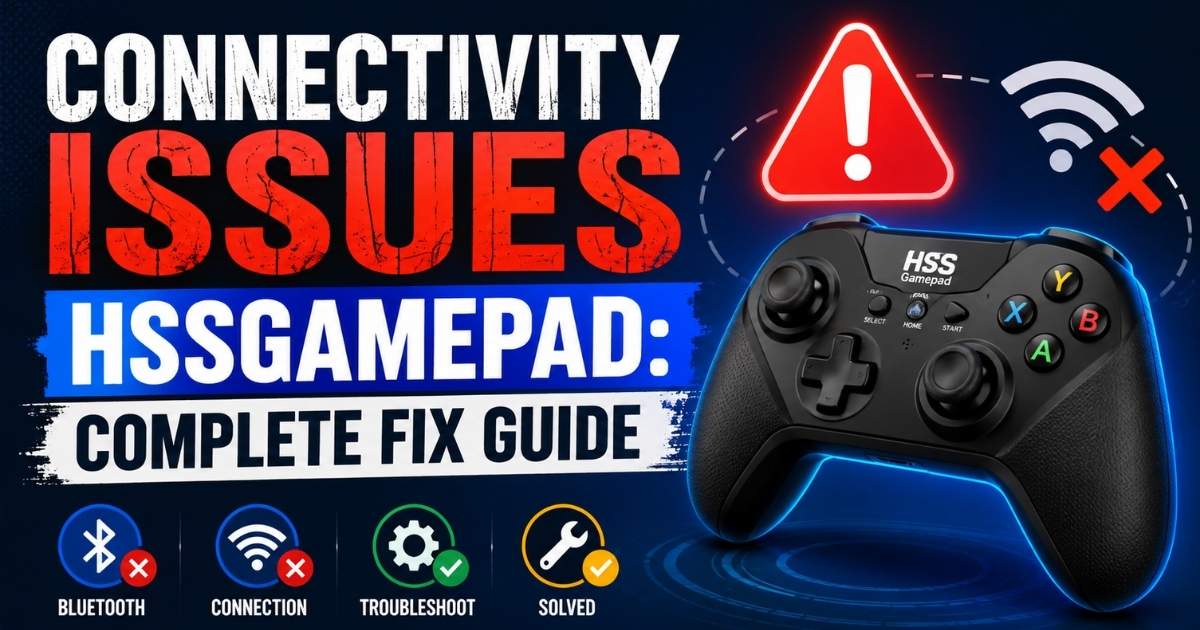
If your HSSGamepad keeps disconnecting, refuses to pair, or suffers from annoying input lag, you are not alone. Connectivity issues HSSGamepad users report are among the most common complaints in wireless gaming today. The good news is that nearly 90% of these problems come down to simple causes like Bluetooth interference, low battery, or outdated firmware — all of which are completely fixable without replacing your controller.
This complete fix guide walks you through every possible cause and solution, from basic restarts to advanced platform-specific troubleshooting. Whether you play on Android, iOS, PC, or console, this article has you covered.
1. Why Stable Connectivity Matters for Gaming Performance
A single millisecond of delay or an unexpected disconnect can cost you a match. In fast-paced games like PUBG Mobile, BGMI, or any competitive title, your controller must respond instantly to every input. When Bluetooth signal quality drops or the connection becomes unstable, your reaction time suffers even if your skills do not.
Stable gamepad connectivity directly affects:
- Input accuracy and response speed
- Overall gaming experience and immersion
- Performance consistency during long sessions
- Compatibility across multiple platforms and game engines
Understanding this makes fixing the problem feel less like a chore and more like a necessary step to protect your gameplay.
Read More: Esports News Dualmedia: The Ultimate Guide to 2026 Pro Gaming Trends
2. Common Connectivity Issues
Gamepad Not Pairing with Device
This is the most frustrating starting point. You hold down the pairing button, the LED flashes, but the device never recognizes the controller. This often happens when old pairing data conflicts with the new connection attempt, or when the controller enters the wrong pairing mode.
Frequent Disconnections
Your HSSGamepad connects fine at first but then drops the signal randomly during gameplay. This is usually tied to Bluetooth interference, power management settings, or signal range limitations.
Input Lag or Delayed Response
You press a button, but the on-screen action happens half a second later. Input lag is one of the most performance-damaging issues and is commonly caused by wireless signal congestion or battery drain weakening the Bluetooth signal.
Device Not Recognizing the Controller
Sometimes the gamepad pairs successfully but does not appear as a recognized input device. This often points to a driver issue on PC or an OTG setting being disabled on Android.
3. Possible Causes of Connectivity Problems
Bluetooth Interference
Your home is full of wireless signals competing for the same 2.4GHz frequency band. Wi-Fi routers, smart bulbs, microwave ovens, and other Bluetooth devices all create signal noise that disrupts your gamepad connection. This is one of the top causes of random disconnections and input lag.
Low Battery or Power Issues
A weak battery does more than simply turn off the controller. It reduces the Bluetooth signal strength, causing the gamepad to struggle maintaining a stable connection even at close range. Always charge before a gaming session.
Outdated Firmware or Drivers
Firmware is the internal software that controls how your gamepad communicates with devices. When it is outdated, it can cause pairing errors, mode confusion, and compatibility failures. The same applies to Bluetooth drivers on your PC.
Compatibility Issues with Devices
Not every device handles third-party gamepads equally. Differences in Bluetooth stack versions, operating system limitations, and hardware specifications can result in detection failures or limited functionality.
Physical Obstructions or Range Limitations
Walls, metal furniture, and large objects weaken Bluetooth signals significantly. Most Bluetooth gamepads work reliably within 8 to 10 meters in open space. Obstacles cut that effective range down considerably.
Read More: How to Improve Software HCS 411gits for Better Performance
4. Basic Troubleshooting Steps
Restarting the Gamepad and Device
A simple restart clears temporary glitches stored in system memory. Turn off both your HSSGamepad and the connected device, wait 10 to 15 seconds, then power them back on. This single step resolves a surprising number of connection problems.
Re-pairing the Controller
Go into your device’s Bluetooth settings and select “Forget” or “Unpair” for any saved HSSGamepad entry. Turn off Bluetooth for about 10 seconds to reset the local radio stack. Then put the gamepad back into pairing mode and reconnect it fresh.
Checking Battery Levels
Charge the HSSGamepad fully before attempting any troubleshooting. A low battery creates a weak Bluetooth signal that causes unreliable connections. Many pairing failures and disconnections disappear entirely once the battery reaches 100%.
Ensuring Bluetooth is Enabled and Working
This sounds obvious, but confirm that Bluetooth is turned on, your device is discoverable, and no airplane mode or battery saver setting is blocking wireless connectivity. On Android, also check that OTG is enabled in Connected Devices settings.
5. Advanced Fixes
Updating Firmware and Drivers
Visit the manufacturer’s website or the app associated with your HSSGamepad and check for available firmware updates. On Windows, open Device Manager, find your Bluetooth adapter, right-click, and select “Update Driver.” Keeping both updated ensures maximum compatibility and connection stability.
Resetting the HSSGamepad
A factory reset erases all stored pairing data and returns the controller to default settings. The method varies by model but typically involves holding a combination of buttons for 5 to 10 seconds until the LED blinks in a reset pattern. After resetting, pair the controller again from scratch.
Clearing Bluetooth Cache
On Android, go to Settings, then Apps, find the Bluetooth app or Bluetooth Share, and clear its cache and data. This removes corrupted pairing records that often cause connection loops and detection failures.
Adjusting System Settings for Better Connectivity
On Windows, open Device Manager and navigate to your Bluetooth adapter properties. Under Power Management, uncheck “Allow the computer to turn off this device to save power.” This prevents Windows from disconnecting the controller during gameplay to conserve battery.
6. Fixing Connectivity Issues on Different Devices
PC (Windows/Mac) Troubleshooting
- Open Device Manager and remove any existing HSSGamepad entries under Bluetooth and Human Interface Devices.
- Reinstall the Bluetooth driver from the adapter manufacturer’s website.
- Avoid plugging a USB Bluetooth dongle into a USB 3.0 port — these ports emit interference that disrupts the 2.4GHz signal.
- Use tools like AntiMicroX or DS4Windows to remap inputs if the controller is detected but not working in specific games.
Android Device Fixes
- Enable OTG support in Settings under Connected Devices.
- Disable battery optimization for both the Bluetooth system and any gamepad companion app.
- Go to Developer Options and ensure Bluetooth HCI snoop log is available to diagnose deeper issues.
- Clear Bluetooth cache as described above and re-pair.
iOS Device Fixes
- Go to Settings, then Bluetooth, tap the “i” icon next to the HSSGamepad, and select “Forget This Device.”
- Re-pair by holding the gamepad’s pairing button until the LED blinks rapidly.
- Note that iOS updates sometimes reset Bluetooth pairings, so re-pairing after major iOS updates is normal.
- Only use games that explicitly support MFi or third-party controllers, as iOS has strict controller API requirements.
Console-Specific Solutions
For users playing through emulators or app-based gaming on consoles, ensure the controller is in the correct mode before pairing. Using a wired USB connection eliminates most Bluetooth-related issues entirely and is always the more reliable option for competitive gaming.
7. Reducing Input Lag and Improving Stability
Optimizing Bluetooth Settings
Keep your HSSGamepad within 5 to 6 feet of the connected device whenever possible. Signal strength drops exponentially with distance, and even moving 2 feet closer can significantly improve stability. Avoid placing devices behind metal surfaces, inside entertainment centers, or near large appliances.
Minimizing Interference from Other Devices
Turn off or disconnect any Bluetooth devices you are not actively using, such as wireless earbuds, speakers, or smartwatches. If your Wi-Fi router is on the 2.4GHz band, switch it to 5GHz only, or manually set the Wi-Fi channel to Channel 1 to reduce frequency overlap with your Bluetooth controller.
Using Wired Connection as an Alternative
When a stable, low-latency connection is non-negotiable, a wired USB connection is your best option. It eliminates all wireless interference, removes signal range limitations, and typically provides a more consistent polling rate than Bluetooth in most setups.
8. When to Seek Professional Help
Identifying Hardware Defects
If you have worked through every troubleshooting step and the problem persists, consider hardware failure as a possible cause. Signs of a hardware defect include the LED not lighting up, the controller not charging, buttons registering without being pressed, or the device never appearing in Bluetooth scans on any device.
Contacting Customer Support
Reach out to the manufacturer’s customer support team with a clear description of the issue and a list of all the steps you have already tried. Most support teams can diagnose problems remotely and may offer a replacement or repair service if the issue is confirmed.
Warranty and Replacement Options
Check your purchase receipt and product documentation for warranty terms. Many controllers come with a 6 to 12 month warranty that covers manufacturing defects. Never attempt to open or modify the controller’s internal hardware before checking warranty status, as this typically voids coverage.
9. Preventive Measures
Regular Firmware Updates
Enable automatic update notifications for your gamepad’s companion app and check for firmware releases at least once a month. Updates frequently include stability improvements, bug fixes, and enhanced compatibility with newer operating system versions.
Proper Storage and Handling
Store the controller in a dry, room-temperature environment away from direct sunlight and moisture. Avoid dropping it or placing heavy objects on top of it. Physical damage to the Bluetooth antenna inside the controller is a common cause of permanently weak signal performance.
Maintaining Optimal Battery Health
Avoid letting the battery drain to zero repeatedly. Charge the gamepad when it reaches around 20% and unplug it once it reaches full charge. Regularly cycling the battery in this range significantly extends its long-term health and helps maintain consistent signal output during gameplay.
Conclusion
Connectivity issues HSSGamepad users experience are almost always solvable with the right approach. Whether the problem is a failed pairing, random disconnections, input lag, or a device recognition error, this guide covers every practical fix available. Start with the basic steps, work up to the advanced fixes, and use the platform-specific solutions for your specific device. Staying on top of firmware updates and following proper storage practices will keep your gamepad running reliably session after session.