

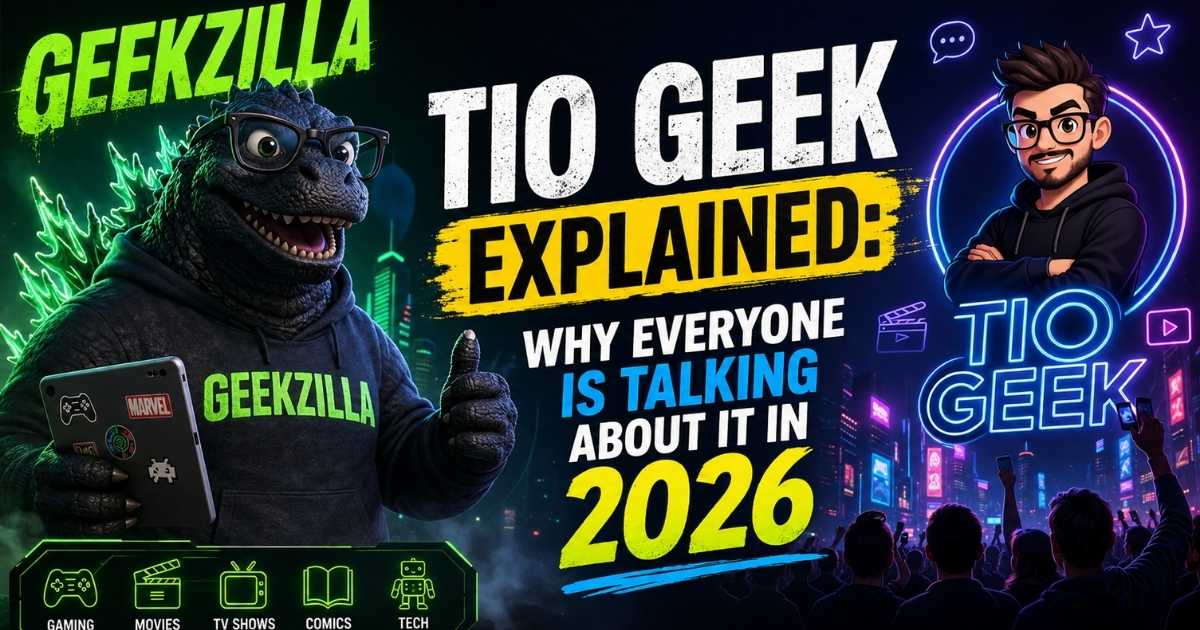
If you spend any time around tech reviews, gaming forums, comic discussions, or creator-led social feeds, you have probably run into the name Geekzilla Tio Geek. It shows up in gadget breakdowns, streaming setup tips, gaming edits, and pop culture commentary. For a name with no single official headquarters or press release, it has an unusually large footprint online.
That contradiction is exactly why so many people search for it. Some readers find it through a microphone review, others through a gaming clip or a comic culture thread. Many just want a straight answer: what actually is this, and why does it keep appearing everywhere in 2026?
This guide breaks it down in plain language, covering what Geekzilla Tio Geek is, how it grew, who is likely behind it, what it publishes, and whether it deserves your trust.
What Is Geekzilla Tio Geek?
Geekzilla Tio Geek is a creator-driven digital brand that blends accessible technology coverage with broader geek culture content, including gaming, comics, movies, and creator gear reviews.
The name itself carries meaning. “Geekzilla” borrows from “geek” and “Godzilla,” suggesting something large, energetic, and impossible to ignore. “Tio Geek” adds a friendlier layer. In Spanish, “tío” translates loosely to “uncle” or “dude,” so the phrase reads like “geek uncle,” a guide who explains things without talking down to you.
Put together, the identity works less like a formal publication and more like a recognizable voice. It is not strictly a person, not strictly a company, and not strictly a media outlet. It behaves like all three at once, which is part of why first-time visitors often struggle to categorize it.
At a functional level, think of Geekzilla Tio Geek as a hybrid:
- A content brand covering tech, gadgets, and audio gear
- A geek culture commentator touching gaming, comics, and film
- A creator-style voice built for short, practical explanations
That combination is unusual for traditional media, but it is increasingly common for digital brands built around 2026-era content habits.
Read More: Hearthstats Net News: Latest Updates, Features & Insights
Why Geekzilla Tio Geek Is Everywhere in 2026
Search and discovery have changed. A few years ago, people typed a query into Google and landed on one large publication. Today, discovery is scattered across short-form video, social feeds, community threads, and AI-generated answer summaries.
Geekzilla Tio Geek benefits from that shift in several ways:
- Its content style fits short-form platforms like Reels, Shorts, and TikTok-style feeds.
- It answers practical questions instead of publishing dense specification sheets.
- Its tone travels well across screenshots, reposts, and remixed clips.
- It sits at the intersection of tech, gaming, and entertainment, so it surfaces in multiple unrelated searches.
There is also a structural reason. Traditional tech publications tend to separate content into rigid categories: reviews in one section, news in another, culture somewhere else entirely. Geekzilla Tio Geek does not respect those walls. A gamer who needs a streaming microphone, a movie fan who also plays games, and a beginner comparing budget smartphones can all land in the same content ecosystem. That overlap mirrors real reader behavior far better than a siloed publication does.
How Geekzilla Tio Geek Started
There is no single confirmed founding story, no funding announcement, and no corporate timeline attached to Geekzilla Tio Geek. What can be reconstructed from its content pattern is a familiar growth arc for internet-native brands.
The early content appears to have centered on simple, relatable topics such as smartphone impressions, quick gadget tips, and beginner-level tech explanations. Nothing highly technical. Nothing gatekept. That accessibility created an easy entry point for casual readers who felt intimidated by traditional tech journalism.
From there, the scope widened gradually:
- Gadget commentary expanded into full product reviews
- Tech explainers grew to include creator tools like microphones and streaming gear
- Coverage stretched further into gaming culture, comics, and movie discussion
This kind of organic, topic-by-topic expansion is typical of content ecosystems that grow through shares and repost cycles rather than paid marketing. The name spreads because people keep tagging or referencing it, not because of a press push.
Who Is Behind Geekzilla Tio Geek?
This is the question most readers actually want answered, and honestly, it does not have one confirmed public answer. Across the web, you will find conflicting claims. Some pages describe a single named creator. Others describe a small editorial team. Several describe it as a fully anonymous content persona with no public “About Us” page at all.
Rather than repeating an unverified claim as fact, it is more useful to understand the pattern:
- There is no verified corporate registration or public leadership team tied to the name.
- The tone stays consistent across content, which suggests either one dedicated voice or a small team following a defined style guide.
- Anonymity or partial identity is not automatically a red flag. Many creator-era brands intentionally keep the “who” secondary to the “what,” because modern audiences often trust a consistent voice more than a corporate bio.
The most accurate description: Geekzilla Tio Geek functions like a creator-driven brand identity rather than a fully transparent media company. If you see a specific founder name claimed online, treat it with caution until an official source confirms it.
What Kind of Content Does Geekzilla Tio Geek Publish?
The content spans several categories, but it consistently favors usefulness over technical depth. Here is how the coverage typically breaks down.
Consumer technology and practical gadget coverage
This is the foundation of the brand. Coverage usually includes:
- Smartphone impressions and comparisons
- Laptop and budget device breakdowns
- Smart home gadgets and everyday accessories
- Buying advice framed around real use cases, not raw specs
Instead of leading with processor architecture, a typical piece explains why a laptop feels slow after two years of use, or which budget phone actually holds up for daily tasks. That framing matters more to a casual buyer than a benchmark chart ever will.
Microphones and creator-focused audio content
Audio gear gets unusually detailed attention, and that makes sense given how many readers are now podcasters, streamers, or remote workers. Microphone content typically covers:
- Clarity and background noise rejection
- Build quality and long-term durability
- Suitability for streaming, podcasting, or video calls
- Budget-friendly versus professional-grade options
The stronger pieces in this category go one step further than most reviews. They do not just state that a microphone has good background noise rejection. They explain what that means in practice, such as reduced keyboard clatter, less room echo, and fewer distracting sounds during a live stream. That extra layer of context is what separates a useful review from a spec dump.
Read More: New Software RCSDASSK: Complete Guide & FAQs
Gaming, gaming culture, and community-driven discussion
Gaming content spans consoles, PC setups, and community-driven commentary. Common topics include:
- Console and PC hardware discussion
- Game reviews and early impressions
- Peripheral advice such as headsets and controllers
- Gaming culture takes and community discussion threads
Because gaming audiences are highly social, this category tends to generate the most comments, shares, and follow-up discussion.
Comics, movies, and broader geek entertainment
Beyond hardware, the brand covers entertainment topics that overlap heavily with tech-savvy audiences:
- Comic releases and storyline discussion
- Movie and streaming series breakdowns
- Anime commentary and recommendations
- Fan theories and pop culture crossover content
This section is what turns the platform from a pure tech outlet into a genuine geek culture hub. It acknowledges that a person who cares about gaming hardware very often also cares about the next superhero movie.
Why the Content Feels Different From Traditional Tech Media
Traditional tech journalism prioritizes precision, structure, and formal analysis, which works well for professionals who already understand the terminology.
Geekzilla Tio Geek takes a different route. The tone reads more like a knowledgeable friend explaining something over coffee than a formal reviewer presenting a spec sheet. That shows up in a few ways:
- Plain language instead of dense technical jargon
- Context explaining why a feature matters, not just that it exists
- Shorter, scannable paragraphs built for mobile reading
- A conversational voice that talks to the reader rather than at them
That stylistic choice is not accidental. It reflects a broader trend where accessible tone consistently outperforms formal authority when it comes to reader engagement and trust among beginner audiences.
Why Beginners Gravitate Toward Geekzilla Tio Geek
New tech buyers and casual gamers often feel overwhelmed by traditional coverage that assumes prior knowledge. Geekzilla Tio Geek removes several common barriers:
- No assumption that the reader already understands specifications
- Recommendations framed around real scenarios, such as “best for beginners” or “good for tight budgets”
- Explanations that connect a feature to an outcome the reader actually cares about
- A tone that feels encouraging rather than exclusionary
For someone buying their first streaming microphone or their first gaming headset, that clarity matters more than a deep engineering breakdown ever could.
Community Matters More Than Ever
Modern readers rarely consume content passively. They comment, share, debate, and compare notes with other readers. Geekzilla Tio Geek leans into that behavior rather than resisting it.
A single gadget review can turn into a comment thread full of alternative suggestions. A gaming take can spark a wider community debate. A microphone comparison can become the resource someone links to a friend setting up their first podcast.
This matters for a few reasons:
- Community interaction increases the shelf life of content well beyond its publish date.
- Shared content builds organic reach without paid promotion.
- Reader trust grows faster inside an active community than inside a one-way publication.
That community layer is arguably as important to the brand’s growth as the content itself.
Why Geekzilla Tio Geek Fits 2026 Media Behavior
Search behavior in 2026 looks very different from a decade ago. AI-generated answer summaries, social discovery feeds, and short-form video have all reshaped how people find information.
Content that thrives in this environment tends to share specific traits:
- Clear, direct answers near the top of the page
- Practical framing instead of abstract theory
- Consistent terminology that AI systems and search engines can easily match to a query
- A recognizable voice that builds familiarity across multiple pieces of content
Geekzilla Tio Geek fits that pattern closely. Its content answers the question a reader is actually asking, rather than burying the answer inside a long technical detour. That structure happens to align well with how both human readers and AI-driven search summaries prefer to extract information.
Is Geekzilla Tio Geek Actually Trustworthy?
Trust online is built through consistency, usefulness, and honesty about limitations, not through corporate credentials alone. Here is how Geekzilla Tio Geek measures up across those factors.
Consistent thematic coverage
The content stays within a recognizable lane: tech, gaming, audio gear, and geek entertainment. That consistency helps readers know what to expect and builds familiarity over time.
Practical usefulness
Most pieces are built around real decisions, such as whether a product is worth buying or which option suits a specific budget. That practical framing is more valuable to a casual reader than raw technical data.
Clear framing
Content generally avoids inflated claims or hype-driven language. Recommendations tend to include both strengths and drawbacks rather than one-sided praise.
Honest limitations
Like most creator-driven content hubs, sourcing depth and formal expert validation are not always visible. Readers looking for laboratory-grade benchmarking or academic-level research should treat this as a starting point rather than a final authority.
Strengths and Limitations of Geekzilla Tio Geek
No platform is perfect for every reader. Understanding both sides helps you use it more effectively.
Where it performs especially well
- Beginner-friendly explanations of confusing tech topics
- Practical buying guidance for gadgets and creator gear
- Broad coverage that connects tech, gaming, and entertainment
- A relatable tone that lowers the barrier to entry for new readers
Where it may not satisfy every reader
- Limited visibility into formal sourcing or lab-level testing methodology
- Less suited to advanced users seeking deep engineering analysis
- Ambiguity around authorship, which some readers may find less reassuring than a named expert byline
- Content that prioritizes speed and accessibility over exhaustive technical depth
Geekzilla Tio Geek vs Traditional Tech Media
| Factor | Geekzilla Tio Geek | Traditional Tech Media |
| Tone | Conversational, friendly | Formal, structured |
| Depth | Practical, usage-focused | Technical, spec-heavy |
| Best for | Beginners, casual buyers | Professionals, advanced users |
| Discovery | Social feeds, search, community shares | Primarily search and direct traffic |
| Identity | Creator-style brand persona | Named authors, editorial teams |
| Update style | Fast, trend-responsive | Scheduled, review-cycle based |
Neither approach replaces the other. A beginner deciding between two budget microphones benefits from the practical framing of a platform like Geekzilla Tio Geek. A professional evaluating enterprise networking hardware still needs the depth of a specialized technical publication. The smartest approach is using each source for what it does best.
What the Future Looks Like
Geekzilla Tio Geek is not an isolated case. It reflects a broader direction that online media is heading toward.
Creator-led authority will grow
Readers increasingly trust a consistent voice over a corporate logo. Expect more brands to lean into personality-driven content rather than purely institutional authority.
Community-driven discovery will expand
Search traffic alone no longer defines reach. Shares, comments, and community recommendations will keep playing a larger role in how content spreads.
Niche specialization will become stronger
Even hybrid platforms tend to develop clear strengths, such as audio gear or beginner tech guidance. Expect more platforms to lean into a signature niche while keeping a broader content umbrella.
Hybrid media will become standard
The line between “tech site,” “gaming outlet,” and “entertainment blog” will keep blurring. Audiences want fewer destinations that cover more of their actual interests, not more single-topic silos.
Practical Advice: How Readers Should Use Geekzilla Tio Geek
To get the most value without overestimating what any single source can offer, keep a few habits in mind:
- Use it as a starting point for beginner-friendly explanations, not a final technical verdict.
- Cross-check high-stakes purchases, such as expensive gaming rigs, against a specialized review outlet.
- Pay attention to community comments and discussion threads, since they often surface real-world experiences a review might miss.
- Treat unclear authorship claims with healthy skepticism rather than assuming any single “founder” story is confirmed fact.
- Bookmark it for quick, practical answers when you need clarity fast rather than an exhaustive deep dive.
Used this way, it becomes a genuinely helpful layer in your research process rather than your only source of truth.
Final Thoughts
Geekzilla Tio Geek is best understood as a modern, creator-style content identity built around accessible tech coverage, gaming culture, and broader geek entertainment. It is not a traditional publication with a clear masthead, and it is not a single verified individual either. It behaves like a hybrid brand shaped by community interest, algorithm-friendly content, and a consistently approachable tone.
That ambiguity is not a weakness. It is part of why the brand travels so well across feeds, forums, and search results in 2026. For readers who want quick, jargon-free answers about gadgets, microphones, gaming gear, or geek entertainment, it fills a real gap that formal tech journalism often leaves open. Just remember to treat it as a helpful starting point, and lean on more specialized sources when a decision truly calls for deep technical scrutiny.
Frequently Asked Questions
What is Geekzilla Tio Geek?
It is a creator-style digital brand covering accessible tech reviews, gaming culture, audio gear, and geek entertainment topics like comics and movies.
Is Geekzilla Tio Geek a real person or a company?
There is no single confirmed public identity. It functions more like a brand persona or small content team than a verified individual or corporate entity.
Is Geekzilla Tio Geek trustworthy?
It appears consistent, practical, and free of obvious scam behavior, though it lacks the formal sourcing depth of established technical publications.
What kind of content does Geekzilla Tio Geek cover?
Tech reviews, gadget buying advice, microphone and audio gear coverage, gaming culture, and entertainment topics like comics and movies.
Is Geekzilla Tio Geek good for beginners?
Yes. Its plain language and practical framing make it especially useful for readers new to tech or gaming topics.
Why is Geekzilla Tio Geek trending in 2026?
Its accessible tone and practical answers fit how people discover content today, through social feeds, community shares, and quick search answers.
Does Geekzilla Tio Geek only cover technology?
No. While tech and gadgets form its core, coverage extends into gaming, comics, movies, and broader geek culture discussion.
Should I rely on it for major purchase decisions?
Use it as a helpful starting point for practical guidance, but cross-check expensive or highly technical purchases against specialized review sources.